Monthly Message - Home > 401(k).
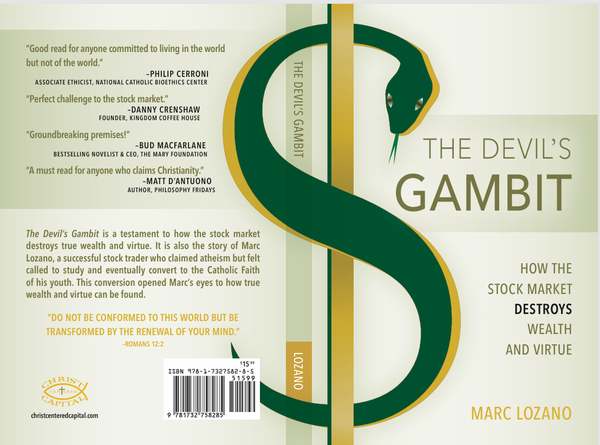
People who have been reading C3 essays since the beginning know my disdain for the secondary markets. I wrote an entire book about why Christians, and human beings in general, should be opposed to stock markets. Throughout my public
speaking engagements and writings, I have laid out biblical, spiritual, philosophical, and economic reasons to be opposed to the stock market. Most people who are genuine admit to the immorality of the market but want an alternative to put in its place. This is also something I have talked about and written extensively on. A 1:1 alternative for speculation does not exist because a 1:1 alternative would be speculative in nature, and then we are back where we started. Hence why I put so much
emphasis on business, community, and family being the real alternative (though I prefer the term “mindset change”).
Yet, the one thing I have not laid out in writing that is somewhat of a closer fit to replacing the stock market that people are looking for is housing. I, and others (think: Dave Ramsey), have talked about this for years. Therefore, I would like to use this month’s essay to concisely
spell out how paying off your house can be done and should be done as a replacement for contributing to your 401(k).
SIDE NOTE: Besides this little side note, I will only speak about economic reasons for doing this. The stock market is a poison on society, and the chief reasons for this are spiritual in nature, but I have written exhaustively about this many times before. Therefore, I will only be
focusing on the financials for the rest of this write-up.
Let’s lay the land…
The average 30-year mortgage monthly payment for a home is in the ballpark of $2,500 (not including property tax or home insurance) in the U.S. This amount changes drastically depending on a whole host of factors, but for the
sake of time let’s just use nationwide averages.
The price of homes goes up on average 3.4% annually (0.5% inflation-adjusted).
The price of the average 401(k) goes up 6.5% annually (4% inflation-adjusted). Those who play the market really well may get upwards of 10% annually with a 6% inflation-adjusted rate. So let’s split the difference for our little example
and say that the average 401(k) contributor will see 8% returns in the market.
With those numbers it seems like a no-brainer. We should all just invest in the market and get that 8%! But wait! Let’s peel back a few more layers on this financial onion.
If I buy a home today in the U.S., the average price
for that home, if it is a 3 bd 2 bth home, will be $400,000. Most of us do not have that in the bank, so we go out and get a mortgage. The cost of that home by the time the mortgage is up will be on average $718,095.47. This assumes the standard 20% down for non–first-time home buyers and no insurance, property tax, or HOA dues.
$700K+ is a big number! But what if you took the average monthly
contribution an American makes to their 401(k) of $499 (and adjust it for inflation and salary raises over the years) and applied it to your monthly mortgage? The amount would reduce the total cost of your mortgage by $207,295, bringing the total cost of your mortgage down to $510,800.43.
Yet, if we just started out and had the average of $1,900 in a 401(k) and our employer was matching our
contributions, then what would we have in our 401(k) at the end of the time frame it would take us to pay off our house if we used that $499 contribution toward our mortgage? Well, that 30-year mortgage would only take 18 years to pay off if we contributed the $499 and our employer gave us a 50% match (all nationwide averages). That brings the math out to having a balance of $237,987.94 in your 401(k) after 18 years if you got a standard 3% raise every year and the market spit out 8% returns
like clockwork.
So if we put our 401(k) contributions into our 401(k), we end up $30K more than what we would have saved if we put that same amount toward paying off our home. However, we cannot touch that 401(k) amount until we turn 59.5 years old. Whereas with your home paid off, you have freed up about $2,500/month and now have a fully paid-off asset that should be worth about $100K more than you
paid for it (proper maintenance assumed).
All this goes without saying that you physically need shelter and a place to store your food and water. You do not have a physical need for binary 1s and 0s on the secondary market.
So at the end of 18 years, would you rather have a paid-for $500K asset that you
can call a home for your family and a monthly income of $2,500 that is not tied to any expenses, or would you rather have $237K in an account you can’t touch until you are in your 60s? Personally, I want the freedom in the here and now. But I suppose other people prioritize security in the future. I think our Lord had something to say about that—Luke 12:16–21.
ONE MORE SIDE NOTE: I do not start the
401(k) off with the same amount of money you would have to put down on a house because, again, you need shelter and most people do not forgo owning a house for a bigger contribution to a 401(k). But hey, maybe you would like to live in a studio apartment for 18 years and not buy your first home until you turn 60. Seems like a waste to me, but to each his own, I suppose.
God bless you
all!!