Revisiting Usury
I try to refrain from binging podcasts, especially politically motivated ones, since I believe that overindulgence in easily accessible information can lead us to focus on things that do not actually matter in our day-to-day lives. Namely, instead of focusing on loving those around us, we
get caught up in things designed to make us stupid: politics, conspiracy theories, and overseas conflicts we have no control over.
However, one of the few podcasts I still listen to is Triggernometry, hosted by Konstantin Kisin and Francis Foster. I find the podcast to be an honest pursuit of truth, even though I disagree with both the hosts and the guests
from time to time. Triggernometry covers a wide range of topics, including geopolitics, American politics, European politics, philosophy, religion, conspiracy theories, and economics.
The latest episode I listened to featured economic historian Niall Ferguson, and I highly suggest giving it a listen. Mr. Ferguson is well-read, articulate, and can be both
profoundly right and profoundly wrong at different times. He is an atheist convert to Christianity, much like me, and this has shaped much of his thinking, again much like me. From what I can gather, Mr. Ferguson and I agree on most things. That said, this essay is about a point of contention.
During the episode, titled “The Debt Crisis No One’s Talking About,” a tremendous amount of information is covered, much of which I can
wholeheartedly endorse. However, the point I want to address concerns lending/usury. For as well-read and intelligent as the hosts and Mr. Ferguson are, they demonstrate either a deep misunderstanding or a lack of knowledge on this issue.
Again, I encourage you to listen to the episode yourself, but I will briefly recap the relevant portion here. All three
acknowledge that at some point in history lending took off and that both Christians and Muslims historically opposed, and in many cases still oppose, the practice, labeling it usury. However, all three dismiss this objection by claiming that Christians and Muslims simply do not understand risk and/or the prosperity that lending has produced.
This line of thinking is naïve and flat-out wrong for multiple reasons.
First and foremost, as the Body of Christ, we know that the ends do not justify the means. Even if lending has produced riches, that does not make it morally acceptable if those riches were generated through theft, coercion, or predatory practices.
Secondly, I firmly believe that lending plays a distant second to
innovation. By this I mean that improvements in nautical navigation played a far greater role in economic prosperity during the 1600s than lending to the East India Trading Company. Likewise, the Industrial Revolution did far more to increase prosperity than the stock market or mass lending ever did.
A common rebuttal is that more dollars were created through lending and speculation than through
industrial or navigational advances. My response is simple: dollar quantity does not equal economic prosperity. We know this all too well living in a deeply indebted 21st-century America, where more dollars are floating around than ever before, yet financial anxiety and instability persist.
So, with the prosperity argument rendered toothless, let’s move on to the
risk argument.
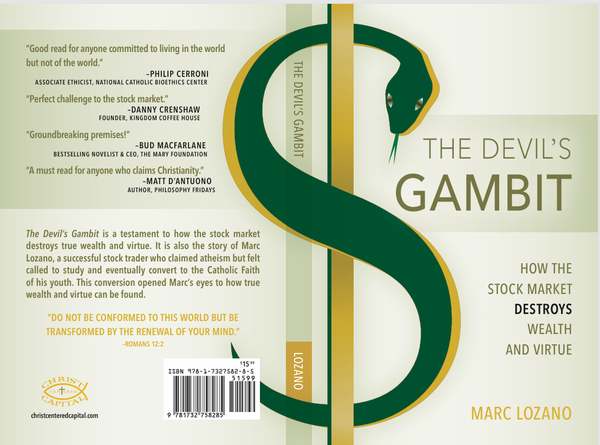
The basic claim here is that when someone lends money, they are taking on risk and therefore deserve compensation for that risk. I address this at length in my book The Devil’s Gambit, but a brief overview is sufficient here. Mr. Ferguson compares lending money to lending a car. This analogy is flawed because a car is fundamentally different
from money.
A car, when lent, experiences wear and tear. Compensation is justified because the owner must maintain the vehicle and will never receive it back in the same condition since there will be additional mileage, worn tires, reduced oil life, and so on. Money, on the other hand, does not experience wear and tear when lent. The only legitimate concern is
inflation eroding its value, and I have always been clear that adjusting repayment for inflation is acceptable since it just getting back the value you lent.
Mr. Ferguson argues that the risk of losing the money is equivalent to the wear and tear on the car. This is an attempt to make an apples-to-oranges comparison appear like apples-to-apples. It also
ignores the reality that the vast majority of lending in the modern world is effectively risk-free. If I default on my loans, creditors can seize my property, garnish my wages, and take me to court. Lending is not risky business in the first world.
Even if there were real risk like in the following hypothetical: I give my neighbor $10,000 to start a business,
and the business fails before turning a profit. I am justified in asking for my $10,000 back, perhaps adjusted for inflation. But there is no justice in saying, “You lost my $10,000, therefore you now owe me $15,000.” Using money to demand more money is predatory, inflation causing, and obviously harmful to neighbor, whom we are called to love. If monetary value was only ever increased when a good or service promoting the common good was provided, then we would live in a much healthier economic
world. Albeit a slower moving world, but I think the word slow has gotten an underserved bad rep in the last century or two.
The typical response to this is that no one would lend if they could not charge profit-reaping interest, and therefore nothing would ever get done. To which I respond: Great! No one would lend. And things would still get done. They would
simply take longer and cost less.
We all want rapid progress all the time, but this obsession leaves out the most important aspects of life. Remember: the poor will always be with us. Constantly striving for some economic paradise is foolish. And despite living in one of the most lending heavy societies in human history, I doubt you could find a single person who
believes we are anywhere close to such a paradise.
The last point that is usually brought up when defending Usury is opportunity cost, which is really the same as risk. The person lending to their neighbor says I will give you the $10K but I could turn that $10K into $15k by doing "x" activity, therefore you should repay me $15K. If the $5K profit was that important to you then just do the "X"
activity. If you truly want to help your neighbor, then the most helpful thing would be to just give him the money he needs (assuming it is for a good cause). This whole narrative about wanting to reap a profit and "help" our neighbor by lending at interest is just bad spiritual and economic practice. It is spiritually bad because we are being uncharitable with our excess, and Charity/Love is the highest calling of the Christian. It is economically bad because we are using money to demand more
money which brings me back to my inflationary and predatory points.
I know no one asked, but here’s my typical podcast list:
- Pints with Aquinas
- Andrew Klavan (I disagree with some of his moral conclusions, but I find him genuine and insightful on
culture)
- Triggernometry
- Bible in a Year
- Joe Rogan (occasionally, depending on the guest)