Frivolous Spending and Stock Market Fear
I have already demonstrated that, from a purely economic perspective, paying off your home is more advantageous than investing in the stock market. That argument can be
found in Home > 401(k) on Christ Centered Capital. I have also spent years laying out the economic, spiritual, scriptural, and philosophical reasons why Christians should avoid participation in secondary markets. The most comprehensive treatment of those arguments can be
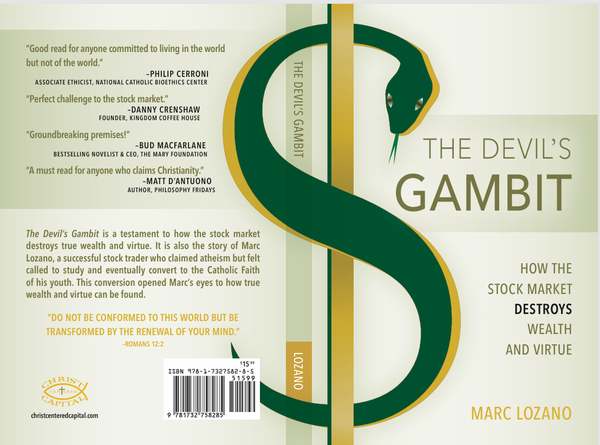
found in my book, The Devil's Gambit.
Yet there remain those who are persuaded by the arguments, or at the very least struggle to refute them, but still refuse to leave the secondary market. Why? Usually because of fear. Fear that they
will become destitute. Fear that they will miss out on gains. Fear that everyone else will get rich while they fall behind.
I have little sympathy for this position but that Is because I am impulsive and convicted and a bit stubborn and zealous as well. I do however understand the fear. I of course had it once to.
Therefore, let us look at some thought-provoking numbers that may subdue the fear.
The average American who owns stock, whether through a brokerage account or a retirement plan, accumulates roughly $350,000 in lifetime market gains after excluding the bottom 5% of investors and the top 5%. The bottom group consists largely of those who lose money or invest very little. The top
group consists of those investing millions of dollars. What remains is the middle of the road investor who participates consistently over a typical 40-year investing career.
Even this figure requires context. Only about 62% of American adults own stock in any form. When those gains are spread across the population as a whole, the average lifetime benefit falls closer to $200,000 per American
adult.
At this point you may be asking, "Where exactly am I supposed to find $350,000 if I am not investing in the market?"
The answer is surprisingly simple.
Most Americans have already found it. They just spend it instead.
Frivolous spending accumulates far faster than most people realize.
Consider a few annual expenses that the average American incurs:
- $5,000 on recreational driving and unnecessary vehicle upgrades.
- $2,500 on voluntary dining out, meaning meals purchased despite having food
available at home.
- $1,000 on alcohol. I am intentionally using a conservative figure here because there is nothing wrong with enjoying a good bottle of wine from time to time. We were created for leisure as well as labor by our Good Lord after all.
- $1,000 on coffee and specialty beverages. Again, this is a low-end
estimate.
Those categories alone total $9,500 per year.
Over forty years, that amounts to $380,000.
Read that number again.
The average
American can spend more money on a handful of discretionary purchases than the average stock-owning American earns from a lifetime of market participation.
And remember, I have stacked the deck in favor of the market.
I used relatively high estimates for lifetime stock market gains. I used relatively low
estimates for discretionary spending. I excluded countless other forms of consumption that quietly drain wealth year after year, including streaming services, impulse purchases, luxury vacations, sports betting, convenience fees, subscriptions, premium electronics, and countless forms of entertainment that have become normalized.
In reality, the gap is likely much larger than presented
here.
The point is not that coffee is evil. The point is not that Christians must never enjoy a meal at a restaurant or take a vacation.
The point is that many people defend their participation in the stock market as a financial necessity when, in reality, much of the wealth they seek has already passed
through their hands.
They are not investing because they need the gains.
They are investing because they want the gains without first confronting the habits that prevent them from accumulating wealth in the first place.
For many households, the path to financial security is not found on Wall Street. It is found in the ordinary disciplines of contentment, moderation, and stewardship. Those virtues may not generate headlines or produce the thrill of watching a portfolio rise, but they have quietly built more wealth than most people realize.
Perhaps the question is not whether we can afford to
leave the market.
Perhaps the question is whether we can afford not to examine where our money is already going.